

Quick Answer
A Kenya safari is a guided wildlife trip through national parks, reserves, and private conservancies, typically costing $150–$300/day (budget), $300–$600/day (mid-range), or $600–$1,500+/day (luxury), all-inclusive of meals, park fees, and game drives. The best time to go is June–October or January–February for dry-season game viewing, with July–October adding the Great Migration's Mara River crossings. Most first-time visitors combine two parks, commonly the Masai Mara and Amboseli, over 7–10 days, booked through a KATO-registered operator 3–6 months ahead.
What Is a Kenya Safari?
A Kenya safari is a guided wildlife-viewing trip across national parks, game reserves, or private conservancies, typically by open 4x4 vehicle with a licensed guide, running morning and evening game drives when animals are most active. "Safari" comes from the Swahili word for "journey" and in practice, a modern Kenya safari extends well past a vehicle-based game drive. It commonly includes walking safaris with armed rangers, night drives in private conservancies, sunrise hot air balloon flights, and cultural visits to Maasai communities.
What separates Kenya from other African safari countries is the combination of wildlife density, ecosystem variety, and infrastructure. Kenya's parks have well-developed road networks, English is widely spoken, and Nairobi's Jomo Kenyatta International Airport connects directly to most major global hubs. That infrastructure reduces the logistical friction of planning a first safari without reducing how wild the experience actually is.
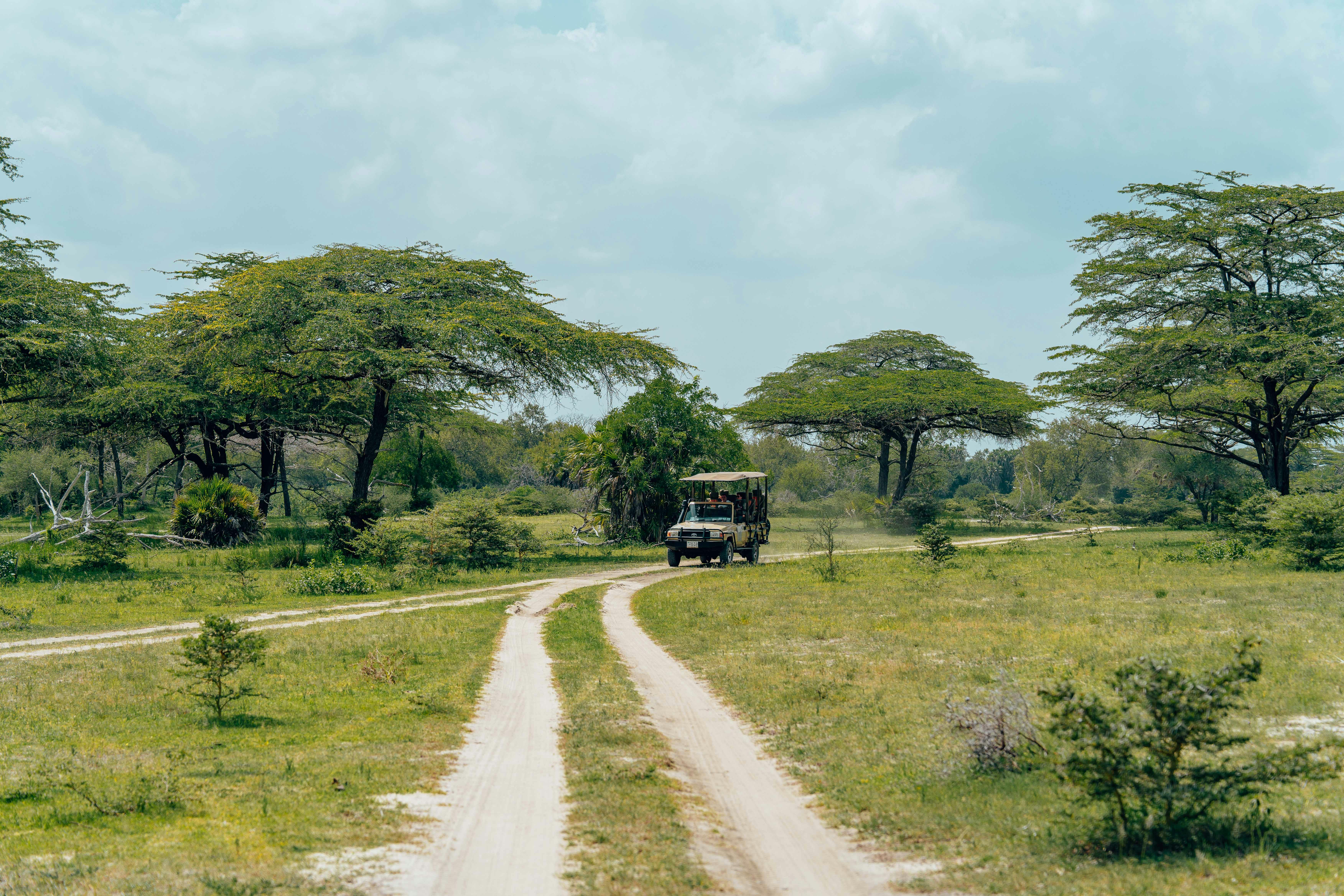
What an actual game drive looks like: departure before sunrise in an open-roof 4x4, guided by a professional naturalist-guide. The best sightings cluster in the first two hours after dawn and the two hours before dusk, when predators are most active. Between drives, most lodges, even mid-range ones, offer hot meals, pools, and guided bush walks. Comfort levels on a mid-range or luxury safari are higher than most first-timers expect.
Why Kenya, Specifically? (vs. Other Safari Countries)
Kenya combines the highest wildlife density in East Africa with ecosystem diversity most single-country safaris can't match, plus infrastructure that makes it the more accessible choice for first-time travelers. Kenya's protected areas cover over 8% of the country's total land area (Source: Kenya Wildlife Service), and within one trip you can see elephants against Kilimanjaro in Amboseli, rhino conservation in Laikipia, flamingos at Lake Nakuru, and the Great Migration in the Masai Mara.
Kenya hosts the full Big Five, lion, leopard, elephant, buffalo, rhino, with Ol Pejeta Conservancy holding one of Africa's last strongholds for both black and white rhino. Beyond the Big Five, Kenya records over 1,100 bird species, roughly 8% of the world's total (Source: Kenya Ornithological Society), making it a genuine birdwatching destination, not just a mammal-focused one. If you're weighing Kenya specifically against Tanzania, see our Kenya vs. Tanzania safari verdict for a category-by-category comparison.
Which National Park Should You Visit?
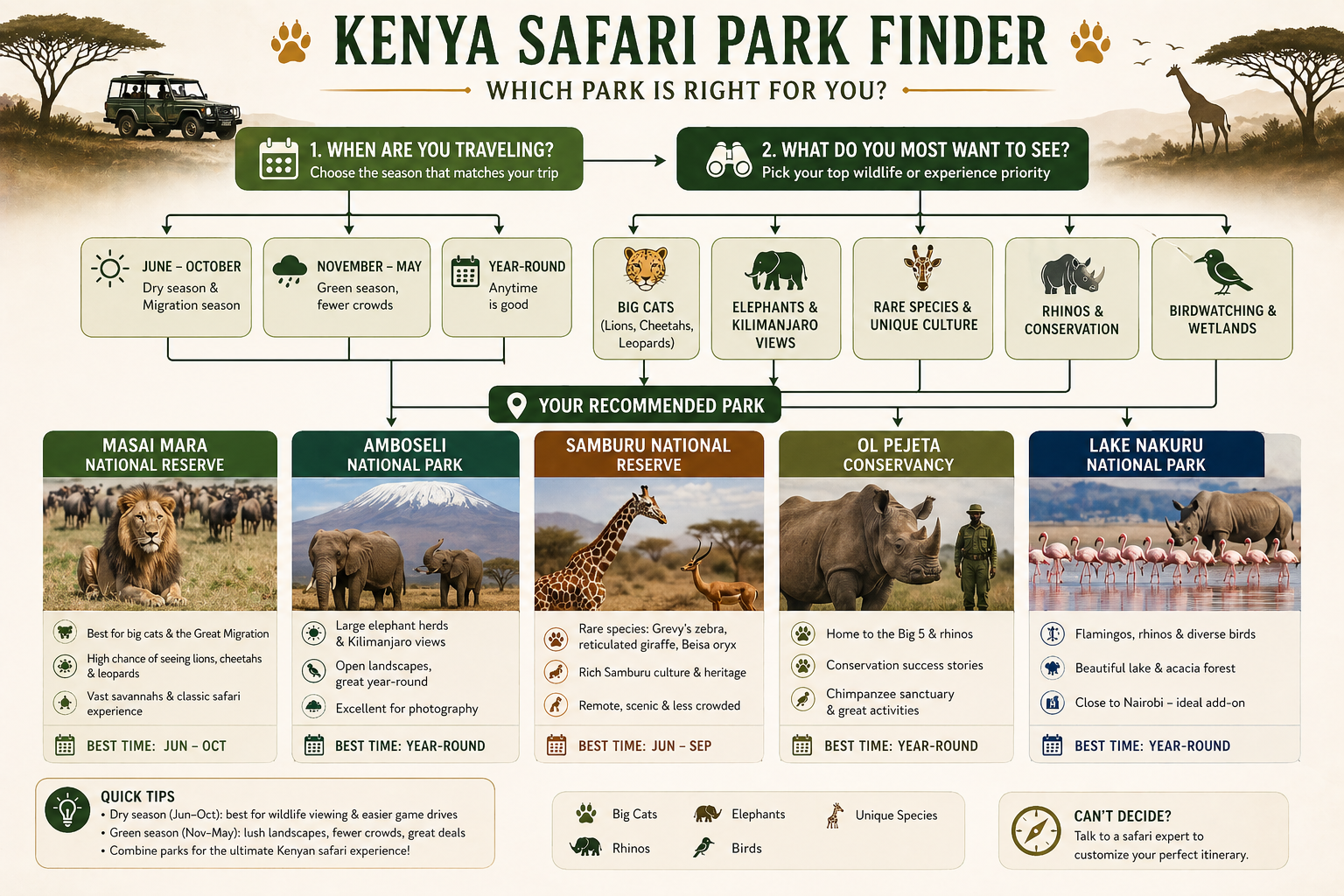
The right Kenya park depends on your travel dates, target wildlife, and budget, most first-time itineraries combine two parks rather than trying to cover everything in one trip.
| Park | Best For | Best Months | Distance from Nairobi |
|---|---|---|---|
| Masai Mara | Big cats, Great Migration | Jul–Oct | 45-min flight |
| Amboseli | Elephants, Kilimanjaro views | Year-round, best Dec–Mar | 4-hr drive |
| Tsavo East & West | Scale, "red elephants," fewer crowds | Jun–Oct | 4–5 hr drive |
| Samburu | Rare northern species | Jun–Sep | 25-min flight |
| Ol Pejeta | Rhino conservation | Year-round | 3-hr drive |
| Lake Nakuru | Flamingos, rhino sanctuary | Nov–Apr | 2.5-hr drive |
| Laikipia Conservancies | Private, low-density wildlife | Year-round | 3-hr drive |
Masai Mara National Reserve is Kenya's most famous destination and the only place on Earth to see the Great Migration's Mara River crossings, when hundreds of thousands of wildebeest cross crocodile-infested water between July and October. It also holds the highest lion density in Africa. Peak season (August–September) brings real crowds; the private conservancies bordering the reserve, Mara North, Naboisho, Olare Motorogi, offer the same ecosystem with far lower vehicle density. See our breakdown of whether the Mara is too crowded if that's a concern.
Amboseli National Park delivers Africa's most photographed combination: elephant herds against Mount Kilimanjaro. At just 392 km², it's small but wildlife-dense, and reachable in a 4-hour drive from Nairobi, a strong choice for shorter itineraries.
Tsavo East and West together form Kenya's largest protected area at over 20,000 km², known for red-dust "red elephants," large lion prides, and noticeably fewer tourist vehicles than the Mara. It pairs naturally with a Mombasa coast extension.
Samburu National Reserve in Kenya's arid north hosts the "Samburu Special Five" reticulated giraffe, Grevy's zebra, Somali ostrich, gerenuk, and beisa oryx, species found nowhere else in the country. It pairs well with the Mara on a 10-day itinerary for maximum wildlife variety.
Ol Pejeta Conservancy in Laikipia is the best place in Kenya, and arguably in Africa, to see rhino at close range, home to the world's largest black rhino sanctuary and the planet's last two northern white rhinos.
Lake Nakuru National Park combines flamingo flocks with a fenced rhino sanctuary, and works well as a one-night stopover between Nairobi and the Mara.
When Is the Best Time for a Kenya Safari?
The best time to visit Kenya for a safari is the dry season, June through October and January through February, when thin vegetation concentrates wildlife around water sources, with July–October also covering the Great Migration's river crossings. Kenya is a year-round destination, but each season has a distinct trade-off between game visibility, crowds, and price.
| Period | Season | Highlights | Crowds & Cost |
|---|---|---|---|
| Jan–Feb | Short dry | Excellent game viewing, calving season in Tanzania | Low–medium, competitive rates |
| Mar–May | Long rains | Lush scenery, strong birdwatching, newborn animals | Lowest crowds, lowest prices |
| Jun–Jul | Dry season begins | Migration enters Kenya, predator activity rising | Crowds building |
| Aug–Sep | Peak dry season | Mara River crossings at their peak | Highest crowds, peak prices |
| Oct | Late dry | Migration tapering, strong big-cat sightings | Crowds easing |
| Nov–Dec | Short rains | Migratory birds arrive, green landscapes | Low–medium, good value |
During a Kenya safari in migration season, the herds enter the Masai Mara from around July and remain through October before returning south, roughly 1.5 million wildebeest, 200,000 zebra, and 500,000 gazelle in total (Source: WWF). The Mara River crossings themselves are unpredictable in exact timing but most likely in August and September. For exact monthly positioning, see our Great Migration month-by-month guide.
Green season (November–May) is genuinely underrated, not just a fallback. Lodge prices typically drop 20–40%, crowds thin out, newborn animals appear across the savannah in January and February, and Kenya becomes an exceptional birdwatching destination as migratory species arrive from Europe and Asia. For budget-conscious or crowd-averse travelers, it's often the smarter booking, not the consolation option.
How Much Does a Kenya Safari Cost?
Kenya safari costs fall into three tiers: $150–$300 per person per day for budget camping safaris, $300–$600 for mid-range tented camps and lodges, and $600–$1,500+ for luxury properties, most rates are all-inclusive of meals, park fees, and game drives.
| Tier | Cost/Person/Day | What's Included |
|---|---|---|
| Budget | $150–$300 | Shared group vehicle, camping/bandas, basic meals |
| Mid-range | $300–$600 | Private/semi-private vehicle, en-suite tented camp, all meals |
| Luxury | $600–$1,500+ | Exclusive-use vehicle, private guide, gourmet dining, extras |
Budget safaris typically mean a shared group vehicle (6–8 people), camping or basic bandas inside the parks, and self-catering or simple meals, well suited to backpackers and those prioritizing wildlife access over comfort. Park entry fees alone can add $80–$100 per person per day in the Masai Mara, so factor that in separately when comparing quotes.
Mid-range safaris are the most popular tier for first-timers and couples: private or semi-private vehicles, comfortable en-suite tented camps or lodges, full board, and consistently high-quality guiding, you don't sacrifice much wildlife access to save meaningfully versus luxury.
Luxury safaris add exclusive-use vehicles, private expert guides, and extras like private hot air balloon flights or helicopter transfers. Top-tier camps such as Mahali Mzuri and Angama Mara regularly appear on global "best hotels in the world" lists.
Additional costs to budget for:
- International flights to Nairobi: $700–$1,800 from the US/UK/Australia, depending on season
- Domestic flights (e.g., Nairobi to Masai Mara): $200–$400 return
- Kenya eTA: approximately $51 per person for most nationalities, see our Kenya visa and entry requirements guide
- Tipping: $10–$20/day per guide, $5–$10/day per lodge staff member, full breakdown in our Kenya safari tipping guide
- Travel insurance: $100–$300 depending on coverage, non-negotiable for safari travel
- Vaccinations: yellow fever required from certain countries of origin; malaria prophylaxis strongly recommended
For a full line-by-line breakdown across every tier, see our dedicated Kenya safari cost guide.
How Do You Plan and Book a Kenya Safari? (Step by Step)
Planning a Kenya safari follows five steps: choose your parks and season, set a realistic budget, decide between a guided operator and self-drive, handle visa and health logistics, and finalize your itinerary 3–6 months before departure.
Step 1 — Choose your parks and season.
Identify your non-negotiable first: if the Great Migration is the priority, you need to be in the Masai Mara between July and October. If elephants and Kilimanjaro views matter more, Amboseli works year-round. Most first-timers combine two parks over 7–10 days, commonly the Mara plus Amboseli, or the Mara plus Samburu.
Step 2 — Set your budget honestly before contacting operators.
The most common first-timer mistake is underestimating total trip cost, a $300/day mid-range safari over 7 nights already approaches $4,500 in accommodation alone, before flights, tips, and insurance.
Step 3 — Decide: guided operator or self-drive?
Self-drive is technically possible in parks like Amboseli but strongly discouraged for first-timers, park roads are often unmarked, wildlife is harder to locate without local knowledge, and regulations vary by park. A KATO-registered operator handles park fees, logistics, accommodation, and expert guiding, and typically saves money through volume rates.
Step 4 — Choose your operator carefully.
Look for KATO membership (Kenya's official tour operator certification), verifiable reviews on TripAdvisor and SafariBookings, and transparent, itemized pricing. Ask every shortlisted operator the same three questions: how many years have your guides worked this specific park; what vehicle will I be in and how many other guests share it; and what is your cancellation and refund policy. See our full guide to choosing a Kenya safari operator, and if you're weighing named operators specifically, our 10 Best Kenya Safari Companies ranking is the place to compare them directly.
Step 5 — Pack and prepare.
Neutral, lightweight clothing (khaki, olive, tan, avoid white and bright colors), binoculars, a wide-brimmed hat, high-SPF sunscreen, and closed-toe shoes for walking safaris. Full checklist in our Kenya safari packing list.
Sample Kenya Safari Itineraries
Itineraries work best when they balance park variety against realistic travel time, flying between parks, rather than driving, is usually what makes multi-park combinations feasible.
5 days (budget–mid-range), from ~$1,200–$2,500/person excluding flights: Day 1 arrive Nairobi; Days 2–4 Masai Mara (3 nights); Day 5 morning game drive, return to Nairobi.
7 days (mid-range): Day 1 arrive Nairobi; Days 2–3 Amboseli; Day 4 fly or drive to the Mara; Days 5–7 Masai Mara, including a hot air balloon safari.
10 days (mid-range to luxury), from ~$4,500–$10,000+/person excluding flights: Day 1 arrive Nairobi; Days 2–3 Amboseli; Day 4 fly to Samburu; Days 5–6 Samburu; Day 7 fly to the Mara; Days 8–10 Masai Mara, including a balloon safari and Maasai village visit, or an extension to Diani Beach.
Safety, Etiquette, and What to Actually Expect
Kenya is safe for safari travelers who visit established parks and reputable lodges with standard precautions, wildlife itself is the main hazard, and experienced guides manage encounters professionally.
Is Kenya safe for tourists? Yes, within its established tourism infrastructure. The most commonly cited safety concerns relate to Nairobi's urban areas at night, not the parks themselves. Standard urban precautions apply: use reputable ride-share apps (Bolt and Uber both operate in Nairobi), avoid displaying valuables, and stay in established neighborhoods when overnighting in the city.
Game drive rules that matter: stay inside the vehicle at all times, this is both a safety rule and a park regulation, since animals treat vehicles as non-threatening but react differently to a standing human. Never feed wildlife, keep noise to a minimum near predators, and follow your guide's instructions immediately during any close encounter.
Tipping is expected and forms a real part of guide income: $10–$20 per day per guide, $5–$10 per day collectively for camp staff, paid in cash (USD or Kenyan shillings) at checkout.
Common first-timer mistakes: booking Mara camps too late (peak-season properties fill 6–12 months out), under-budgeting for park fees and domestic flights, over-scheduling four parks into seven days, skipping malaria prophylaxis, and packing bright colors that can disturb wildlife.
Insider Tips Most Generic Guides Won't Tell You
A few things that don't show up in most "ultimate guide" articles, but consistently change how a trip actually goes:
- The best game viewing window is narrower than people assume, the first two hours after sunrise and the two hours before sunset account for most predator activity. A midday game drive is mostly a scenic drive.
- A private vehicle changes the experience more than a nicer camp does. On a shared group vehicle, you don't control pace, stops, or how long you linger at a sighting, for photographers or anyone with children, this matters more than an extra star rating on the lodge.
- The "quiet weeks" inside peak season exist. Late June and early October sit just outside the true August–September crush but still deliver strong migration-adjacent wildlife, worth asking your operator about specifically if you want peak-season sightings without peak-season crowds.
- Travelers from the Gulf and Middle East have strong direct routing into Kenya via Dubai, Doha, and Abu Dhabi into Nairobi, making a Kenya safari a realistically short-haul trip from the region compared to routing through Europe first.
Experiences Beyond the Game Drive
A Kenya safari extends well past game drives into hot air balloon flights, cultural visits, rhino tracking, and coastal extensions that turn a wildlife trip into a fuller Africa journey.
Hot air balloon safari over the Masai Mara, a 60–90 minute sunrise flight over the savannah, typically ending in a champagne bush breakfast, at roughly $450–$550 per person.
Maasai village cultural visits, genuine visits, arranged through a lodge with a real community partnership, involve direct payment to the community rather than a middleman, and give real insight into Maasai herding, beekeeping, and craft traditions. Avoid visits that feel staged; ask upfront how community payments are structured.
Rhino tracking on foot at Lewa or Ol Pejeta, an armed-ranger-guided walking encounter with black rhino, fundamentally different from a vehicle sighting, and directly tied to breeding and anti-poaching programs.
Beach extension to Diani or Mombasa, a 1-hour flight from Nairobi turns a Kenya safari into a bush-and-beach trip; see our Diani Beach guide for extension options.
Walking safaris, available in Laikipia and select Mara conservancies with armed ranger guides; see our complete guide to walking safaris in Kenya for where to go and what to expect.
Frequently Asked Questions
What is the best time to visit Kenya for a safari?
June through October and January through February, when dry conditions concentrate wildlife around water. July–October additionally covers the Great Migration's Mara River crossings.
How much does a Kenya safari cost per day?
Roughly $150–$300/day for budget safaris, $300–$600/day mid-range, and $600–$1,500+/day for luxury, most rates include meals, park fees, and game drives.
Do US or UK citizens need a visa for Kenya?
Yes. Most travelers need a Kenya eTA (Electronic Travel Authorization), applied for online before departure, approval must be granted before you fly, as it has replaced visa-on-arrival.
What is the best Kenya safari for first-time visitors?
A 7-day safari centered on the Masai Mara, with a possible extension to Amboseli or Samburu, gives the best balance of wildlife variety, logistical simplicity, and value.
How many days do I need for a Kenya safari?
6–10 days covers two parks comfortably without excessive travel time. Under 5 days is workable for a single-park trip but leaves little room for a second ecosystem.
Can I combine a Kenya safari with Tanzania?
Yes, a combined itinerary typically pairs the Masai Mara with the Serengeti to cover both the river crossings and the calving season. See our Kenya and Tanzania safari packages.
Is a Kenya safari during migration season worth the higher price and crowds?
For most travelers, yes, the Mara River crossings are a genuinely rare wildlife spectacle. If crowds are a concern, book a private conservancy camp bordering the reserve rather than the public reserve itself, or travel in late June or early October for migration-adjacent wildlife with fewer vehicles.
Is a Kenya Safari Worth It?
Yes, for most travelers who go, it becomes one of the defining trips of their life, and the practical barriers (cost, distance, complexity) are all manageable with the right planning. The framework is straightforward: choose your parks based on season and priorities, budget honestly and completely, book with a KATO-certified operator well in advance, and add at least one experience beyond the standard game drive.
Ready to plan? Get a free, no-obligation Kenya safari quote →










Comments (0)
Leave a Comment
No comments yet. Be the first to comment!